
Goods-In for Research Material: A Receiving Procedure for Peptide Shipments
Receiving is four decisions taken in a fixed order — inspect, reconcile, record, assign a status — and the standards that describe it were written for regulated warehouses that a research bench can borrow from for free.
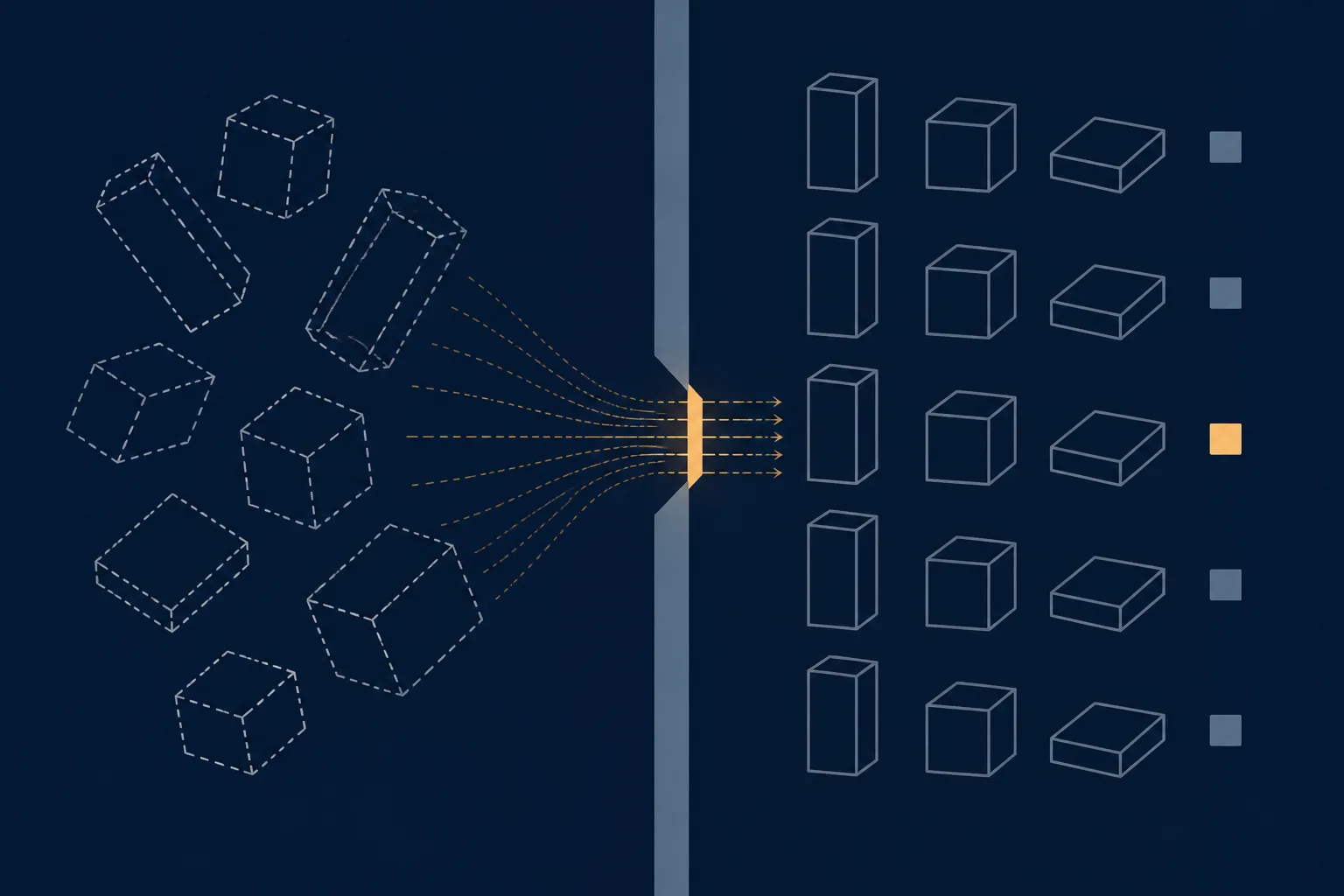
A goods-in procedure is four decisions taken in a fixed order before anything is put away: accept or refuse the parcel at the door; examine the outer and inner containers without opening the primary container; reconcile what physically arrived against the paperwork that claims to describe it; and assign every container a status — released, quarantined or rejected — that determines where it goes next. Ten minutes, performed the same way every time, is the difference between an inventory you can audit backwards two years from now and a cold store full of anonymous containers whose provenance is a memory. Above that line the shipment is a courier's problem; the signature is where it becomes yours.
None of this needs inventing. The receiving step is one of the most heavily written-down operations in the regulated world: ICH Q7 gives it a section of its own, requiring that each container be examined visually on receipt and held under quarantine until examined and released [1]; US drug manufacturing regulation says the same thing in fewer words at 21 CFR 211.82 [2]; and ISO/IEC 17025 requires an accredited laboratory to hold a documented procedure covering transportation, receipt, handling, protection and storage of incoming items, together with a system for identifying them unambiguously [4]. None of those rules bind a research purchaser, and claiming otherwise would be theatre. What they provide is a tested shape, free to copy, for an operation most benches perform by instinct.
What to check before you sign for the parcel
The delivery record is the only document in the chain that both parties can annotate contemporaneously, and the opportunity ends when the driver leaves. Damage noted on it is a fact; damage discovered an hour later is a claim. So the first inspection is of the outer packaging, at the door, while someone else is still standing there — under a minute, and the only part of this procedure with a hard deadline. Photograph the parcel in its shipping state with the label legible; that single image settles most later disagreements about who damaged what.
- Outer carton condition: crushing, punctures, water staining, or a re-taped seam that does not match the carrier's own tape.
- The shipping label against your order: consignee, address and the number of pieces the carrier says it is delivering.
- Weight and feel against the packing list — a light box for a declared cold shipment usually means the coolant is gone.
- Any external temperature indicator or shock label, read and photographed before the carton is moved indoors.
- Elapsed time between the carrier's delivery scan and your first handling — an unattended hour on a loading bay is part of the transit record [6].
- Hazard information on the outer label: labels on incoming containers must not be removed or defaced, and that includes the shipping carton [11].
The visual examination: what you are actually looking for
The regulated version of this check is specific enough to copy verbatim. ICH Q7 §7.20 asks that each container or grouping of containers be examined visually for correct labelling — explicitly including the correlation between the name the supplier uses and the name you use internally, when they differ — and for container damage, broken seals, and evidence of tampering or contamination [1]. The US regulation phrases it as examination for appropriate labelling as to contents, container damage or broken seals, and contamination, upon receipt and before acceptance [2]. Note what is absent from both: nothing about opening the primary container, nothing about assessing the material itself. This is an examination of packaging, identity and documentation, performed with the closure intact.
- Container count against the packing list, and the packing list against the invoice — three numbers that should agree and frequently do not.
- The lot or batch number printed on each container, read individually rather than assumed uniform across the box.
- That the lot number on the container matches the lot on the certificate of analysis supplied with it; a certificate for a different lot describes different material.
- Closure and seal integrity: crimp seated evenly, stopper fully home, no residue on the outside of the closure.
- Physical state of the contents as visible through the container wall — a lyophilised solid that has collapsed, discoloured or migrated is an observation to record, not a verdict to act on alone.
- That a safety data sheet accompanied or preceded the shipment and is accessible where the material is handled, as hazard communication rules require of the employer receiving it [11].
Quarantine is a status, not a shelf
Quarantine causes more confusion than any other word here, because people hear it as a room. It is a status: material that has arrived but has not yet been examined, reconciled and released is not available for use, and something must make that unambiguous to anyone who opens the door. In a facility that is a caged area. On a bench it can be a labelled bin, a coloured tag or a field in the inventory record — provided the identification is unambiguous and the status is visible without asking anyone [4]. The rule underneath is what matters: incoming material stays in quarantine until examined and released, and released material never mixes with unreleased stock of the same item [1][2].
| Observed on arrival | Status | Action | What the record must show |
|---|---|---|---|
| Outer carton crushed or water-stained, containers intact | Quarantine | Annotate the carrier's record before signing; photograph as received | Photographs, the annotation, condition of each inner container |
| Broken seal, loose closure or evidence of tampering | Reject | Stop; do not open further; notify the supplier the same day | Photograph of the seal, the lot number, time of discovery |
| Coolant thawed or absent on a shipment declared cold | Quarantine | Read any logger; ask the supplier for the declared transport condition | Coolant state, logger summary, elapsed transit time |
| Container lot number does not match the certificate | Quarantine | Request the batch-matched certificate; do not file under the wrong number | Both numbers exactly as written, and the supplier's reply |
| Count or item differs from the packing list | Quarantine the discrepancy, not the delivery | Reconcile against invoice and order before opening anything else | Quantity ordered, quantity listed, quantity present |
| Containers, seals, labels and counts all agree | Released | Assign the receiving code; hand over to the storage procedure | Receiving code, date of receipt, who examined it |
Reading the shipment's thermal history
Arrival condition is evidence about transit, and it is worth interpreting against defined terms rather than impressions. The compendial definitions are public: controlled room temperature is a thermostatically maintained 20–25 °C, with a mean kinetic temperature calculated at not more than 25 °C, excursions between 15 °C and 30 °C tolerated, and transient spikes up to 40 °C permitted provided they do not exceed 24 hours; cold is 2–8 °C, and a freezer is −25 °C to −10 °C [5]. WHO's model guidance for time- and temperature-sensitive products expects the transport condition to be specified in advance and any deviation recorded rather than absorbed silently [6]. If a logger travelled with the shipment, the European standard for such recorders spans −80 °C to +85 °C and defines an accuracy class of ±0.2 °C across the −25 °C to +7 °C band [7].
Now the honest part. A thawed gel pack is not proof that anything degraded, and a frozen one is not proof that nothing did. Lyophilised solids are considerably more resistant than solutions, but they are not inert: the solid-state literature documents deamidation, peptide-bond hydrolysis, oxidation, β-elimination, aggregation and Maillard reactions in dried protein and peptide systems, with residual moisture, temperature and the amorphous or crystalline state governing the rate [12]. What it cannot give you is the answer you want — whether this sequence, in this formulation, survived this excursion — because that is formulation-specific and the data rarely exist outside the manufacturer's files. The defensible response is procedural: record the excursion, ask the supplier what transport condition was specified and what supports it, and keep that record attached to the lot.
What the goods-in log has to record
The field list does not have to be invented either. US drug manufacturing records regulation specifies, for each incoming shipment, the identity and quantity of each lot received, the name of the supplier, the supplier's lot number where known, the receiving code assigned by the receiver, the date of receipt, and the name and location of the prime manufacturer where different and known [3]. Almost all of it survives translation to a research purchase, where it becomes the front half of the record set a lot carries from receipt through to preparation, because those fields exist to answer one question: if this material turns out to be wrong, what else came from the same place and where did it go?
- Your own receiving code — sequential, assigned on arrival, and distinct from the supplier's lot. Two shipments of the same catalogue item are two receipts, even when the lot is identical [3].
- Date and time of receipt, and the name of the person who performed the examination.
- Supplier, invoice or order reference, carrier and tracking number.
- Item as described by the supplier, and the internal name you use for it if the two differ [1].
- Supplier lot or batch number, transcribed from the container rather than from the paperwork.
- Quantity ordered, quantity on the packing list, quantity physically present.
- Certificate of analysis reference, and explicitly whether it is lot-matched to what arrived.
- Condition on arrival: packaging, seals, coolant state, logger reading, any external indicator.
- Status assigned — quarantined, released or rejected — with the date it changed and who changed it [2], and where the material was then placed.
When the shipment crossed a border into the US or Canada
For a US or Canadian recipient the goods-in file is also a customs file, and the retention clocks run longer than most people assume. US recordkeeping regulation requires import records to be kept five years from the date of entry, or five years from the activity that created the record [8]. Canada's requirement is longer: records relating to origin, purchase, importation, cost, value, payment and disposal of commercial goods must be kept for six years following the year of importation, normally at a place of business in Canada unless the agency authorises otherwise [9]. Keep the commercial invoice, air waybill, entry number and broker correspondence in the same folder as the receiving record.
Detention is the other thing worth understanding before it happens rather than during. Under US law, customs must issue a notice to the importer no later than five days, excluding weekends and holidays, after the decision to detain is made; merchandise not released within 30 days of presentation is deemed excluded by operation of law, which is the point at which an administrative protest becomes available [10]. Two consequences follow. A shipment that has gone quiet for a fortnight has a documented status somewhere, and you are entitled to it. And a research-use-only description on an invoice is a statement of intended use, not an exemption: admissibility is decided by the agency with jurisdiction over the article.
When something is wrong: the nonconformance path
The instinct on finding a problem is to investigate it — open the next container, unwrap the packaging, see how bad it is. That instinct destroys the evidence supporting a claim. ICH Q7 does the opposite with damaged or mislabelled containers: quarantine first, investigate under a documented procedure second, dispose only under a decision that is itself recorded [1]. ISO/IEC 17025 makes the same move for incoming items whose suitability is in doubt, requiring the deviation to be recorded and the customer consulted before work proceeds [4]. Both reduce to a short sequence that needs no judgement calls.
- Stop unpacking. Leave the packaging, coolant, logger and labels exactly as they arrived.
- Photograph the discrepancy in place, with the lot number and the outer label visible in at least one frame.
- Segregate the affected containers under an unambiguous quarantine identification, separate from released stock [1].
- Notify the supplier in writing the same day, quoting the receiving code, the lot and the specific observation; most suppliers' claim windows are short and start on delivery, not on discovery.
- Record the outcome against the receipt — replacement, credit, or acceptance with a documented rationale — so the file explains itself without anyone remembering the conversation [3].
Where receiving ends and storage begins
Goods-in is finished the moment three things are true: every container has a status, every container has an identification tying it to a receiving record, and that record ties it to a supplier lot and a certificate. Nothing about the conditions a lyophilised solid is held under once it is put away, container selection, aliquoting or reconstitution belongs here — those are storage and handling operations with their own records and failure modes. Drawing the boundary deliberately keeps both procedures short enough to be followed at speed, with a courier waiting at the door.
What a receiving procedure cannot tell you
Everything above verifies packaging, paperwork and provenance. None of it verifies the molecule. An intact crimp seal is evidence that a container was not opened in transit; it says nothing about what was put inside before it was sealed, and a certificate of analysis remains the supplier's assertion until something independent confirms it. The regulated framework is candid about that gap and closes it specifically: a supplier's certificate may substitute for full incoming testing only where the receiver performs at least one test verifying the identity of each batch, alongside an established basis for relying on that supplier [1]. That is the honest endpoint of goods-in — a documented, identified lot with a known history, ready for whatever verification you can actually perform. The receiving record is what makes a later analytical result interpretable, since a purity percentage measures a narrower thing than it is usually read as measuring, and with no transit history attached to it, it cannot separate a manufacturing problem from a shipping one [12].
References
- Q7 Good Manufacturing Practice Guidance for Active Pharmaceutical IngredientsU.S. Food and Drug Administration / ICH, 2001
- 21 CFR 211.82 — Receipt and storage of untested components, drug product containers, and closuresU.S. Code of Federal Regulations (Electronic CFR), 2024
- 21 CFR 211.184 — Component, drug product container, closure, and labeling recordsU.S. Code of Federal Regulations (Electronic CFR), 2024
- ISO/IEC 17025:2017 — General requirements for the competence of testing and calibration laboratoriesInternational Organization for Standardization / International Electrotechnical Commission, 2017
- General Chapter ⟨659⟩ Packaging and Storage RequirementsUnited States Pharmacopeia–National Formulary (USP–NF)
- Model guidance for the storage and transport of time- and temperature-sensitive pharmaceutical products (Annex 9, WHO Technical Report Series No. 961)World Health Organization, 2011
- EN 12830:2018 — Temperature recorders for the transport, storage and distribution of temperature sensitive goods: Tests, performance, suitabilityEuropean Committee for Standardization (CEN), 2018
- 19 CFR Part 163 — RecordkeepingU.S. Code of Federal Regulations (Electronic CFR), 2024
- Memorandum D17-1-21: Maintenance of Records in Canada by ImportersCanada Border Services Agency, 2024
- 19 U.S.C. § 1499 — Examination of merchandiseUnited States Code (Legal Information Institute, Cornell Law School), 2024
- 29 CFR 1910.1200 — Hazard CommunicationU.S. Occupational Safety and Health Administration / Electronic CFR, 2024
- Solid-state chemical stability of proteins and peptidesJournal of Pharmaceutical Sciences, 1999