
When Two Laboratories Disagree: Deciding Whether a Purity Gap Matters, and What to Do Next
Your own result and the supplier's certificate do not match. A buyer's decision procedure: how large a gap is normal, what to check first, when a difference is material, and how to raise it with a supplier without starting a fight.
A difference between your independent result and the supplier's certificate is expected, and on its own it is not a finding. A gap of a point or two in chromatographic purity between two laboratories using different methods is normal. A gap that exceeds the combined uncertainty of the two results, persists after the methods are compared, or comes with an identity result that does not match the stated sequence is material, and is worth raising. The job is to tell which kind you have before deciding anything.
This page is the decision procedure. The chromatographic reasons a gap arises — wavelength, gradient, column, integration — are explained in full in why two laboratories report different purity for one batch, and are summarised here only as far as a decision needs them. What follows assumes you have both reports in front of you and want to know what to do.
How large a difference is normal?
Some disagreement between laboratories is built into measurement. A multi-laboratory study of peptide quantification, organised around oxytocin, compared chromatographic assay, quantitative NMR and amino acid analysis across participating laboratories and found that reproducibility differed measurably between methods, even under agreed protocols on controlled material [4]. Commercial laboratories working to their own in-house methods on containers sent separately will disagree at least as much. As a working rule, a gap of a point or two between two HPLC purity figures obtained by different methods needs no action beyond a note in your records; ten points needs explaining.
Check the methods first
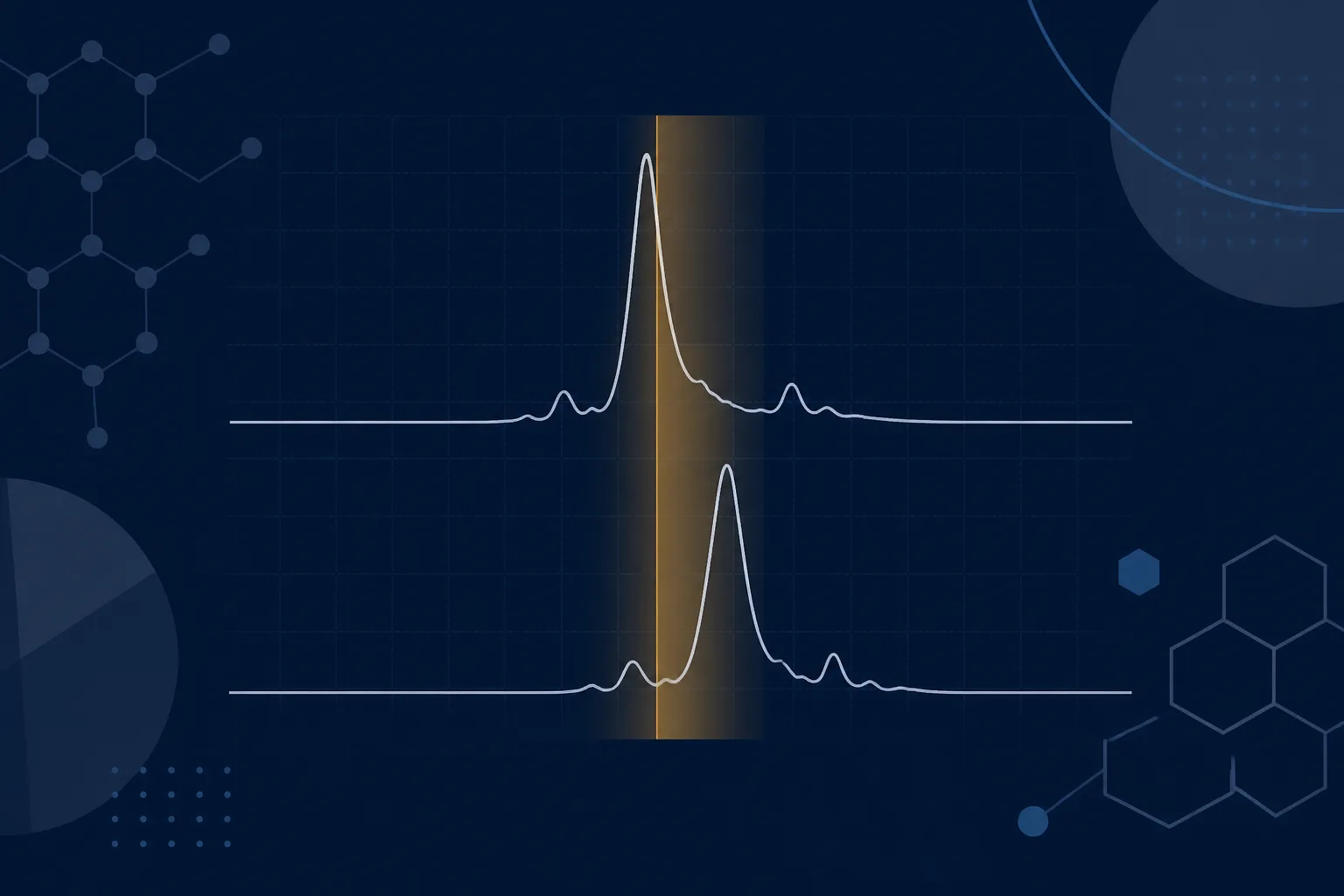
Most gaps close once the two methods are placed side by side. The pharmacopoeial chromatography chapter treats column, mobile phase, gradient and detection wavelength as conditions that define the result, which is why they must be stated [1]. Peak integration matters as much: the way software splits a partly resolved shoulder from the main peak changes the reported area, and different splitting rules give systematically different errors [7]. A method that fails to resolve an impurity counts it as product, so the higher figure is not automatically the better measurement; validation guidance puts specificity first for that reason [2].
| Compare on both reports | If they differ |
|---|---|
| Detection wavelength | Different impurities absorb differently; figures are not directly comparable |
| Column and gradient | Closely related impurities may separate on one and merge on the other |
| Integration shown or not | Without the chromatogram, a shoulder absorbed into the main peak cannot be seen |
| What 'purity' means | Area-percent is not net peptide content; the two are different quantities |
| Identity result | A mass mismatch is a finding in its own right, whatever the purity |
Measurement uncertainty and overlapping ranges
Where both reports state measurement uncertainty, the test is simple: if the two results, each with its uncertainty, overlap, they do not disagree in any meaningful sense [3]. ISO/IEC 17025 expects uncertainty to be reported where it is relevant to interpreting a result [6], and a comparison between two laboratories is exactly that case. Where only one report states it, or neither does, you cannot draw the line precisely, and you should say so rather than treat the gap as settled either way. The arithmetic of combining two uncertainties is worked through in how measurement uncertainty is estimated and combined.
Sample heterogeneity and sampling error
The two laboratories may not have analysed the same thing. The supplier's certificate describes a sample taken at release; your result describes one container, months later, after shipping and storage. Oxidation and deamidation continue slowly in the solid, and a container tested later may show new peaks that were never on the release chromatogram. Check that both reports name the same lot, that your identifier is on yours, and that your container was stored as the label directs. A gap explained by age or storage is real information, but it is not evidence that the certificate was wrong when it was issued [6].
When the difference is genuinely material
- The identity result does not match the stated sequence, whatever the purity figures say.
- The purity gap exceeds the combined uncertainty of the two results [3].
- The gap persists after methods, integration and lot identity have been compared [1].
- Your chromatogram shows a substantial peak that does not appear on the certificate at all.
- A second test on your reserve container reproduces your first result.
Settle a material gap with more data, not argument. Regulated practice distinguishes retesting, which uses the same homogeneous material that produced the original result, from resampling, which draws new material from the lot, and treats both as parts of an investigation rather than repeated attempts until a preferred number appears [5]. For a buyer, that means sending the reserve container you retained, ideally to a laboratory using a stated, specific method, and recording both results whatever they show. The wider frame for this is set out in how a laboratory investigates an out-of-specification result.
What not to conclude from a gap
A disagreement invites conclusions the evidence rarely supports. Before writing anything down as a finding, check it against this list. Each item is a common false alarm, and each has a plainer explanation that should be ruled out first [1] [3].
- That the lower figure is the true one. A method that separates impurities better reports a lower purity, and so does one that integrates shoulders more strictly; neither makes the higher figure dishonest.
- That the certificate was falsified. A genuine release result and a later result on a stored container can both be correct descriptions of the material at two different times.
- That the material contains less peptide. Chromatographic area-percent is not net peptide content; a purity gap says nothing about how much peptide is in the container.
- That one result settles it. A single analysis is one measurement on one container; a reproduced result on the reserve is what turns a gap into a finding.
- That the laboratory you paid is the better one. Commissioning a test makes it independent of the supplier, not automatically more accurate [2].
Recording the comparison
Whatever the outcome, write the comparison down against the lot while both reports are in front of you. Record the two figures, the two methods with their wavelengths and columns, any stated uncertainties, the dates of receipt and analysis on each report, how your container was stored, and what you concluded and why [6]. A note that says 'gap of two points, different wavelengths, within combined uncertainty, no action' is as valuable as a note recording a material finding, because it stops the same question being asked again by the next person who opens the file, and because it shows that the difference was examined rather than ignored.
Raising it with a supplier constructively
Most suppliers want to know when a lot tests differently, because a real problem affects every buyer of that lot and a false alarm is cheaply resolved by comparing methods. Write as a colleague with a measurement question, not as a complainant with a verdict. A message that attaches both reports, names the lot, and asks specific questions about method will usually get a specific answer.
- Attach your report and the certificate, and quote the lot string from the label.
- State the two figures, the two methods and, where available, the two uncertainties [3].
- Ask for the release chromatogram and the method conditions behind the certificate [1].
- Ask whether other buyers of the same lot have reported anything similar.
- If identity is the issue, say so plainly and ask how the supplier confirmed it.
- Record the reply, and the resolution, against the lot.
The honest outcome of most disagreements is that both results were competent descriptions of the same material under different conditions. The useful outcome of the rest is a documented finding, backed by a reproduced result on your reserve, that a supplier can act on. Either way, the record of what was compared and why is worth more than the original number [6].
References
- <621> ChromatographyUnited States Pharmacopeia, 2022
- ICH Q2(R2) Validation of Analytical ProceduresInternational Council for Harmonisation of Technical Requirements for Pharmaceuticals for Human Use, 2023
- Quantifying Uncertainty in Analytical Measurement, Eurachem/CITAC Guide CG 4, third editionEurachem/CITAC, 2012
- Survey of peptide quantification methods and comparison of their reproducibility: A case study using oxytocinJournal of Pharmaceutical and Biomedical Analysis, 2019
- Investigating Out-of-Specification (OOS) Test Results for Pharmaceutical Production — Level 2 revisionU.S. Food and Drug Administration, 2022
- ISO/IEC 17025:2017 — General requirements for the competence of testing and calibration laboratoriesInternational Organization for Standardization / International Electrotechnical Commission, 2017
- Integration Errors in Chromatographic Analysis, Part I: Peaks of Approximately Equal SizeLCGC North America, 2006